Dear Little Sis,
So, you are now officially a freshman in high school. As the older, cooler, more experienced sister, I feel obligated to give you some advice, as much as you say you don't want to hear it. ;) Feel free to thank me later.
First of all, no matter what anyone tells you, bring a jacket, at least a light one. Our school is notorious for being indecisive when it comes to A.C. and heating. One room could be ninety degrees and the room next to it could be -30. (That's an exaggeration, but it doesn't feel like it when you're shivering and sweating through it.)
Also, ask questions. It's not dumb or stupid, so don't feel like you're above it. You'll be the one laughing when you don't have to sit through test retakes at 8 o'clock in the morning because you asked 37 questions BEFORE the test. ;)
On another note, I know you're worried about memorizing the layout of the school, and I could try explaining it in words but I think we both know how that's going to turn out so I'm just going to save my breath and say you will get used to it by the end of the first month, don't worry.
As a high schooler in a school that thoughtfully employs teachers that seem to have just gotten out of college, it is totally okay to have a crush on a teacher and - gasp - think one or two of them are hot. What's not okay is to act on it in any way other than gossiping about it with your friends. That's when you start getting into illegal territory. If you think I'm crazy, just wait. I give it a week before you start liking that science teacher of yours.
Lockers are only useful if you want them to be. I know a ton of people that didn't use their lockers once, and instead carried around as little amount of stuff as possible but still had everything they needed. I don't know how they did it, because I used my locker religiously between every single class, so you're going to have to figure that one out on your own.
Don't forget, there's a whole other school of kids that are joining you this year, (that's why there's freakin' 700 of you,) so branch out and expand your group of friends. A great way to do this (other than basketball, cough cough,) is through clubs. There are clubs that look good on college applications, and there are clubs that are actually fun. I suggest a mixture of both. (German club is kind of stupid though, just so you know.)
Finally, listen to the song "Brave" by Sara Bareilles. Listen, and pay attention. That's my final piece of advice for you. Good luck, dork. <3
Love, Your Big Sis
P.S. - I'm always available, if you can find me, for help if you need it. So are all of my friends.
P.P.S. - NEVER be the first one in the cafeteria. If you have to hide out in the stall of a bathroom for an extra five minutes, do it. Never be the one sitting at a table alone.
Showing posts with label op-ed. Show all posts
Showing posts with label op-ed. Show all posts
Thursday, August 29, 2013

Sunday, August 11, 2013
As an Honorary Member of the Breakfast Club
One of my favorite movies of all time is The Breakfast Club. As I've mentioned before in my post about Ferris Beuller, John Hughes is one of my career idols, and his movies never fail to impress me. In accordance to The Breakfast Club, there is so much subtle cleverness contained within that one movie, I pick up on something new every time I watch it, and because of that, I want to share my findings and opinions with you.
First, I found a connection to the name "The Breakfast Club" and the actual plot line. Near the beginning of the movie, John Bender (played by Judd Nelson) is talking to Claire and Andrew (played by Molly Ringwald and Emilio Estevez, respectively,) about clubs and the difference between social clubs and academic clubs. It's basically a metaphor for high schoolers' struggle to find their place. Then, at the end, during the voice-over of the final letter to Mr. Vernon, Anthony Michael Hall's character, Brian, describes their random assembly of awkward new friends as "The Breakfast Club." I take this to mean, in a very literal sense, they are now a club of people with something in common, having spent the morning (the time for "breakfast,") and afternoon together. They didn't know each other, at least not in the way that counts, before that Saturday morning, and now they were friends because they shared an unspoken bond with each other. Within that short time, they found their place.
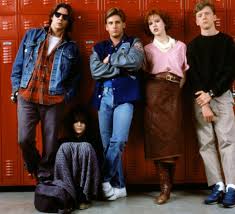
Second, I recognized the connection between the five teens. Andrew, the athlete, "can't think for himself," and therefore deems it easier to just do what people expect of him than to act like his own person. It's his defense mechanism because he's afraid people won't like the real him. Claire, the princess, admittedly "hates going along with everything her friends say" and is also therefore not her own person. But again, she's also afraid of branching out because then she wouldn't be popular and accepted, and she's scared of that, because clearly the only attention she gets is from her peers, seeing as her parents apparently couldn't care less about her. Brian, the brain, is so driven to get perfect grades because he has such high expectations for himself and he knows his parents do, as well. He took wood shop for the easy A, to keep his GPA up. When he realized that it was actually not as easy as he thought, and got an F on a project, he couldn't handle it. He doesn't know what to think of himself when he fails, and doesn't know how to keep going from that point. He's so driven by the expectations of himself and other people that he can't learn from his mistakes and failures because he thinks he shouldn't have made those mistakes or failed in the first place. In a way, he's not in control of his own life. Allison, the basket case, would rather people assume she's a weirdo than have them judge her as a real person. She, as well, uses a facade to protect herself against the judgement of her peers. And finally, Bender, the criminal, acts up and gets in trouble because after a certain point, people started expecting that from him. He comes from a troubled home, and is always being punished for things that aren't his fault, so in a sad sort of way, he's used to being in trouble. He uses this label to protect himself, because he would rather have people think he's scary, a criminal, or troubled, than have them know that he's actually upset and insecure. He reminds me in a way of Heath Ledger's character, Patrick Verona, in the movie "10 Things I Hate About You," (another favorite of mine). They both put up a front because it's easier than explaining themselves to others who wouldn't understand. In my opinion, the reason why the Breakfast Club works is because underneath all the stereotypes and labels, they all have a common insecurity with themselves and their lives, and once they open up to each other about these thoughts and fears, they bond on a level most teens can't even comprehend. If more teens opened up to each other about their insecurities and worries, I think it would make us realize that we have more in common than we usually like to admit. If we could just recognize this, it would help us better understand and eventually help each other.

Another thing I realized while watching this movie for the umpteenth time was Mr. Vernon's attitude towards John Bender. It really got to me once I understood it. Mr. Vernon treats Bender like a low-life scum that's just going to end up in jail. He doesn't once try to understand Bender or his situation at home, nor does he seem to care to even try. He would rather label him and be done with the punishment than try and help him. I think this is another reason that Bender really believes he is a criminal and won't achieve anything in life. His peers tell him it wouldn't matter if he disappeared tomorrow because no one would notice or care. His parents treat him like utter shit (excuse my language,) and even his teachers have given up on him. It explains why he's so angry and defensive and full of angst. Anyone would be, if they were constantly being ripped on the way Bender was. In a way, he's a victim of stereotyping, and as a result, a victim of bullying as well. Once you understand why Bender is the way he is, it's hard not to feel bad for him.

Overall, this movie is one of my favorites because every time I watch it, I pick up on something new. There's always a new aspect of the movie to fall in love with. I adore the characters and the story line, and the fact that it all takes place in one single day. It's so simple at first glance, but so complex once you take a deeper look. It's absolute cinematic genius. John Hughes, in my opinion, was a revolutionary, and I can only hope my aspiring film career produces such projects that really stick with people, and make them feel. I want my future movies to be just as timeless as his.
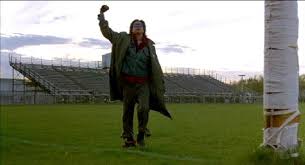
P.S.- The Breakfast Club and 2 otherJohn Hughes movies, Pretty in Pink, and Ferris Beuller's Day Off, are on Netflix instant. I highly suggest you watch all of them if you haven't already.
First, I found a connection to the name "The Breakfast Club" and the actual plot line. Near the beginning of the movie, John Bender (played by Judd Nelson) is talking to Claire and Andrew (played by Molly Ringwald and Emilio Estevez, respectively,) about clubs and the difference between social clubs and academic clubs. It's basically a metaphor for high schoolers' struggle to find their place. Then, at the end, during the voice-over of the final letter to Mr. Vernon, Anthony Michael Hall's character, Brian, describes their random assembly of awkward new friends as "The Breakfast Club." I take this to mean, in a very literal sense, they are now a club of people with something in common, having spent the morning (the time for "breakfast,") and afternoon together. They didn't know each other, at least not in the way that counts, before that Saturday morning, and now they were friends because they shared an unspoken bond with each other. Within that short time, they found their place.
Second, I recognized the connection between the five teens. Andrew, the athlete, "can't think for himself," and therefore deems it easier to just do what people expect of him than to act like his own person. It's his defense mechanism because he's afraid people won't like the real him. Claire, the princess, admittedly "hates going along with everything her friends say" and is also therefore not her own person. But again, she's also afraid of branching out because then she wouldn't be popular and accepted, and she's scared of that, because clearly the only attention she gets is from her peers, seeing as her parents apparently couldn't care less about her. Brian, the brain, is so driven to get perfect grades because he has such high expectations for himself and he knows his parents do, as well. He took wood shop for the easy A, to keep his GPA up. When he realized that it was actually not as easy as he thought, and got an F on a project, he couldn't handle it. He doesn't know what to think of himself when he fails, and doesn't know how to keep going from that point. He's so driven by the expectations of himself and other people that he can't learn from his mistakes and failures because he thinks he shouldn't have made those mistakes or failed in the first place. In a way, he's not in control of his own life. Allison, the basket case, would rather people assume she's a weirdo than have them judge her as a real person. She, as well, uses a facade to protect herself against the judgement of her peers. And finally, Bender, the criminal, acts up and gets in trouble because after a certain point, people started expecting that from him. He comes from a troubled home, and is always being punished for things that aren't his fault, so in a sad sort of way, he's used to being in trouble. He uses this label to protect himself, because he would rather have people think he's scary, a criminal, or troubled, than have them know that he's actually upset and insecure. He reminds me in a way of Heath Ledger's character, Patrick Verona, in the movie "10 Things I Hate About You," (another favorite of mine). They both put up a front because it's easier than explaining themselves to others who wouldn't understand. In my opinion, the reason why the Breakfast Club works is because underneath all the stereotypes and labels, they all have a common insecurity with themselves and their lives, and once they open up to each other about these thoughts and fears, they bond on a level most teens can't even comprehend. If more teens opened up to each other about their insecurities and worries, I think it would make us realize that we have more in common than we usually like to admit. If we could just recognize this, it would help us better understand and eventually help each other.

Another thing I realized while watching this movie for the umpteenth time was Mr. Vernon's attitude towards John Bender. It really got to me once I understood it. Mr. Vernon treats Bender like a low-life scum that's just going to end up in jail. He doesn't once try to understand Bender or his situation at home, nor does he seem to care to even try. He would rather label him and be done with the punishment than try and help him. I think this is another reason that Bender really believes he is a criminal and won't achieve anything in life. His peers tell him it wouldn't matter if he disappeared tomorrow because no one would notice or care. His parents treat him like utter shit (excuse my language,) and even his teachers have given up on him. It explains why he's so angry and defensive and full of angst. Anyone would be, if they were constantly being ripped on the way Bender was. In a way, he's a victim of stereotyping, and as a result, a victim of bullying as well. Once you understand why Bender is the way he is, it's hard not to feel bad for him.
Overall, this movie is one of my favorites because every time I watch it, I pick up on something new. There's always a new aspect of the movie to fall in love with. I adore the characters and the story line, and the fact that it all takes place in one single day. It's so simple at first glance, but so complex once you take a deeper look. It's absolute cinematic genius. John Hughes, in my opinion, was a revolutionary, and I can only hope my aspiring film career produces such projects that really stick with people, and make them feel. I want my future movies to be just as timeless as his.
P.S.- The Breakfast Club and 2 otherJohn Hughes movies, Pretty in Pink, and Ferris Beuller's Day Off, are on Netflix instant. I highly suggest you watch all of them if you haven't already.
Wednesday, June 26, 2013
In Defense of T. Swizzle
So, as many of you know, Miss Taylor Swift has come a long way since her "Picture to Burn" days, but at the same time, not much has changed in reference to her fantastical romantic notions. She's known for nearly always placing the blame on the boy in a relationship gone wrong, and has many people criticizing her for not realizing the common denominator in all her relationships. But then again, not all of her songs are about breakup. Some of them are about new romance, new love, or a relationship that actually worked, in the case of "Mine."

So, why am I writing this, you're probably asking. It's because I want to make an attempt to defend Taylor, as a fellow girl. A lot of her songs include overly-romanticized ideals about relationships between two people, how the man should always be chivalrous and sweet, otherwise he's a monster. There's even a Twitter account under the tag @feministtswift which changes certain Swift lyrics to be more, well, feminist. I don't necessarily disagree with this Twitter account, because it makes me realize that in a lot of her songs, Taylor expects to be treated as something other than equal to a man, though not in a bad way. She is expressing her want for a fairy-tale romance, which is just not rational. But at the same time we have to realize, for Taylor, her songs are like her diary, and she's letting us read it. We have no right to criticize someone's fantasies, however screwed they may be. She's simply expressing how she wishes things were. I don't believe she is completely delusional to how men really act, as exemplified in the sheer amount of guys she's rumored to have dated, which should be evidence enough.

It's not wrong for a woman to want to be treated right by a man, or even wish that he put in a little effort to be more romantic and Ryan Gosling-like. What's wrong is to not admit that maybe you, as the female, could put in more effort to appeal to your partner. It's wrong to expect that he give up everything that makes him happy to go out and do whatever you want to make you happy. A relationship has to be a two way street with give and take on both sides for it to work, and I think most people's problem with Taylor Swift and her songs is that she nearly always portrays herself as either the victim or the doted-upon princess. Don't get me wrong, I do like her as an artist, but I see where she's kind of missing the mark, so to speak. Sure, there are songs in which she admits to being at fault, such as "Back to December," but most people remember her for "I Knew You Were Trouble" and "We Are Never, Ever Getting Back Together," which are kind of self-indicting in this case. Overall, I think Taylor Swift is majorly successful because she appeals to the wannabe-princess-slash-Rachel-McAdams in all of us girls out there, but she can definitely improve by writing songs in which blame is placed on those who truly deserve it. I think this will come with age though, because look at this way - at least she's not still writing about being Juliet Capulet.

P.S. - Keep in mind, if we're going to criticize Taylor Swift for portraying herself as somewhat of a princess, why can't we criticize male musicians who portray women as prostitutional low-lifes who were made only to provide sexual pleasure to men? Because I mean, really, they're both distorted portrayals of women, but we only seem to focus on the extreme presented by a girl. Which makes everything you argue complete hypocrisy. Just remember that. ;)

So, why am I writing this, you're probably asking. It's because I want to make an attempt to defend Taylor, as a fellow girl. A lot of her songs include overly-romanticized ideals about relationships between two people, how the man should always be chivalrous and sweet, otherwise he's a monster. There's even a Twitter account under the tag @feministtswift which changes certain Swift lyrics to be more, well, feminist. I don't necessarily disagree with this Twitter account, because it makes me realize that in a lot of her songs, Taylor expects to be treated as something other than equal to a man, though not in a bad way. She is expressing her want for a fairy-tale romance, which is just not rational. But at the same time we have to realize, for Taylor, her songs are like her diary, and she's letting us read it. We have no right to criticize someone's fantasies, however screwed they may be. She's simply expressing how she wishes things were. I don't believe she is completely delusional to how men really act, as exemplified in the sheer amount of guys she's rumored to have dated, which should be evidence enough.

It's not wrong for a woman to want to be treated right by a man, or even wish that he put in a little effort to be more romantic and Ryan Gosling-like. What's wrong is to not admit that maybe you, as the female, could put in more effort to appeal to your partner. It's wrong to expect that he give up everything that makes him happy to go out and do whatever you want to make you happy. A relationship has to be a two way street with give and take on both sides for it to work, and I think most people's problem with Taylor Swift and her songs is that she nearly always portrays herself as either the victim or the doted-upon princess. Don't get me wrong, I do like her as an artist, but I see where she's kind of missing the mark, so to speak. Sure, there are songs in which she admits to being at fault, such as "Back to December," but most people remember her for "I Knew You Were Trouble" and "We Are Never, Ever Getting Back Together," which are kind of self-indicting in this case. Overall, I think Taylor Swift is majorly successful because she appeals to the wannabe-princess-slash-Rachel-McAdams in all of us girls out there, but she can definitely improve by writing songs in which blame is placed on those who truly deserve it. I think this will come with age though, because look at this way - at least she's not still writing about being Juliet Capulet.
P.S. - Keep in mind, if we're going to criticize Taylor Swift for portraying herself as somewhat of a princess, why can't we criticize male musicians who portray women as prostitutional low-lifes who were made only to provide sexual pleasure to men? Because I mean, really, they're both distorted portrayals of women, but we only seem to focus on the extreme presented by a girl. Which makes everything you argue complete hypocrisy. Just remember that. ;)
UPDATE: I recently saw an article in the Huffington Post stating that the Westboro Baptist Church is now calling Swift a "whore." For whatever reason they are claiming, this is not ok. It's people like this that create chaos, promote injustice and inequality, and allow hatred to spread. Not ok.
Sunday, June 23, 2013
"That's So Heterosexual!"
I've realized that the majority of the words we use on an everyday basis have become so screwed up. We use terms referring to mental illnesses or handicaps, like "psychopath" and "retard" and things like "I'm totally raping you right now," and even "That's so gay," and it's all become so normal and practically okay. But the thing is, by using these slurs in every day conversation, we're promoting the dismissal of these types of people as less than human, like they aren't good enough to even be referred to as just as human as the rest of us. We are using these words as labels for things we don't like, for things we find derogatory or not normal. What we forget to realize when we use these words are that they aren't supposed to mean the things we are using them for. "Gay" shouldn't mean cowardly or bad, "retarded" shouldn't mean stupid, and using the term "rape" to talk about being victorious over someone else is just on another level of wrong. It's hard to understand how these terms might be offensive if you're not gay, not mentally handicapped, and have never been raped. I, myself, do not fall under any of these categories, and I risk sounding ignorant by saying these things. But I feel that it should stem from basic human compassion to realize that these adjectives shouldn't be used for anything other than what they were intended for. To further prove my point, check out this short film I found a while ago on Tumblr, in which the homosexual/heterosexual situations are reversed.
Sunday, June 2, 2013
Paying for Public School
Just to give you a more complete mental picture of myself, I'll let you know that I'm in high school. Of course, I'm not going to tell you which high school, or where, or what grade I'm in, but at least now you know. It will help this post make a lot more sense.

So, at my school, people have a lot of problems with the way things are run. It's a public school, but they tell us how to take our notes, how to use our electronics, what classes to take, how to spend our study period, etc. Most of those things are greatly overlooked, though, after the shock wears off after the first month of freshman year. But there are some things that just can't be ignored. Like the fact that the school nurse CHARGES GIRLS FOR PADS AND TAMPONS. The first time you need one, it's a warning, but after that, it's $0.50 for tampons and I think $1.00 for pads.
In my humble opinion, that is the most fascist thing I've ever witnessed, let alone the fact that it happens in a public high school. Not to brag or anything, because God knows I couldn't care less, but my school district has a lot of money. So why the hell do they have to charge us for everything? Right down to freaking pads and tampons! What's next? Charging for lockers? It just shows how ill-prioritized the school board and superintendent are, because while we have enough to buy Promethean boards for EVERY. SINGLE. CLASSROOM. We don't have enough to buy better textbooks, hire better teachers, or give students what they medically need, (i.e.- PADS AND TAMPONS.) I mean, really. Does the chorus room, gym, and art room really need a Promethean board?
Subscribe to:
Posts (Atom)